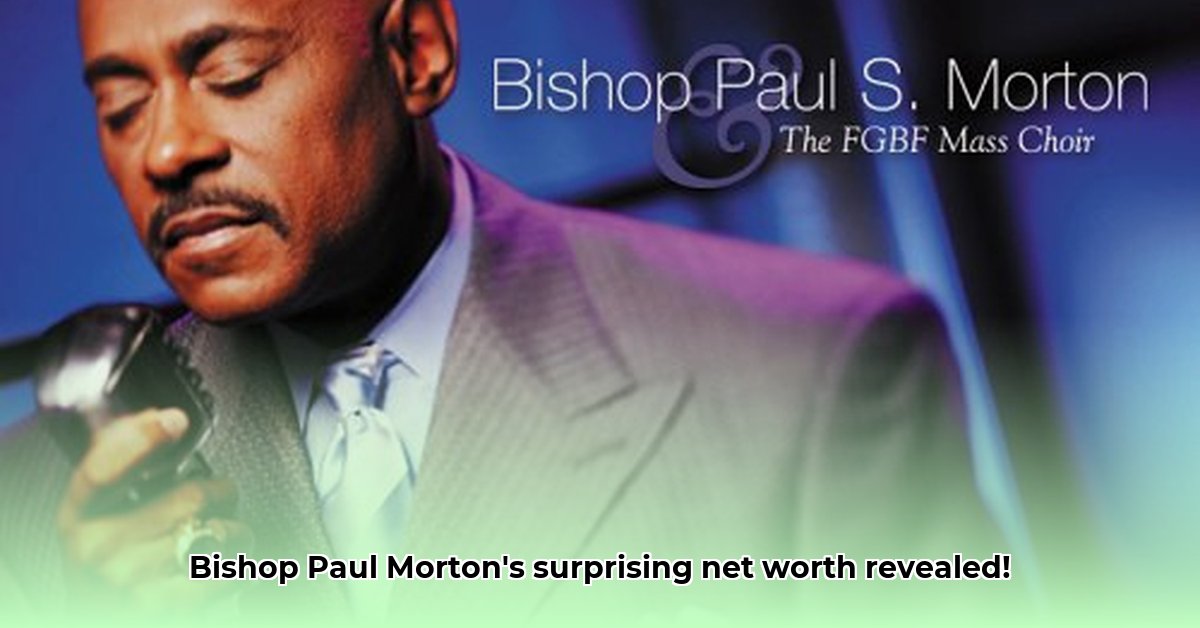
The Elusive Net Worth: A Focus on Impact
Determining Bishop Paul Morton's net worth presents a significant challenge. Public figures, particularly religious leaders, often maintain privacy regarding their personal finances. While a precise figure remains elusive, analyzing the substantial impact of his ministry provides a richer understanding of his legacy. This impact extends far beyond any potential personal wealth. How has Bishop Morton's leadership shaped his expansive religious network? For comparison, see information on other religious leaders' finances here.
More Than a Church: A Vast Network of Influence
Bishop Morton's influence transcends Greater St. Stephen Full Gospel Baptist Church. His leadership of the Full Gospel Baptist Church Fellowship International (FGBCFI) has resulted in a network encompassing over 1,500 churches—a remarkable testament to his organizational capabilities. Furthermore, his entrepreneurial ventures, including Tehillah Music Group and Tehillah Magazine, demonstrate business acumen. While these ventures undoubtedly generate revenue, directly linking this income to his personal net worth remains speculative. Is the success of these enterprises reflective of his overall leadership abilities, rather than a direct indication of personal wealth?
Measuring the Immeasurable: Impact Beyond Financial Metrics
Quantifying Bishop Morton's influence requires moving beyond monetary metrics. His ministry has demonstrably improved countless lives. The significant growth of his churches under his leadership speaks volumes. His commitment to education through affiliated Bible colleges provides opportunities for countless individuals. The Paul S. Morton, Sr. Foundation extends his charitable efforts beyond his immediate congregation. While significant, assigning a monetary value to this extensive community impact proves virtually impossible. How do we accurately quantify the value of spiritual guidance and community building?
The Complexities of Leading a Large Organization
The FGBCFI's impressive growth presents both opportunities and challenges. Maintaining doctrinal unity and financial integrity across numerous churches requires exceptional leadership and robust systems. Transparency and accountability in financial management are paramount for long-term stability. How does the organization's structure influence the financial picture, and what strategies are employed for efficient resource allocation? What are the operational complexities of managing such a wide-ranging network?
Navigating Growth: Challenges and Strategies for Continued Success
Sustaining the FGBCFI's trajectory demands meticulous planning and effective execution. Strong leadership remains central to navigating the complexities of managing a vast religious organization. Financial stability is crucial for ongoing expansion and the fulfillment of the organization's mission. Succession planning, ensuring the continuity of leadership after Bishop Morton, is critical for the organization's long-term health and sustainability. What are the essential components of a successful succession plan to maintain the organization's momentum?
Uncertainties and Future Directions: The Limitations of Public Data
Researching the financial details of large religious organizations inherently presents difficulties. Public information is often limited, and the nature of faith-based work often blends personal and organizational finances. While ongoing research might illuminate the FGBCFI's financial operations, certain aspects might remain opaque. The debate surrounding transparency in religious organizations underscores the complexities inherent in this area.
A Legacy of Faith and Influence: Concluding Thoughts
While the precise figure of Bishop Paul Morton's net worth remains unknown, his true wealth lies in his spiritual guidance, community building, and enduring legacy. His story underscores the limitations of defining leadership solely by financial metrics. His impact resonates through the lives he's touched and the enduring organization he's built—a testament to a legacy of faith that continues to grow and evolve. What factors contribute to the long-term sustainability of faith-based organizations, and how can Bishop Morton's experience inform future leaders?